Sacred places
Bodh Gaya
Gaya district, south-central Bihar
Where the Buddha found enlightenment — and the world found a pilgrimage.
Plan Your Journey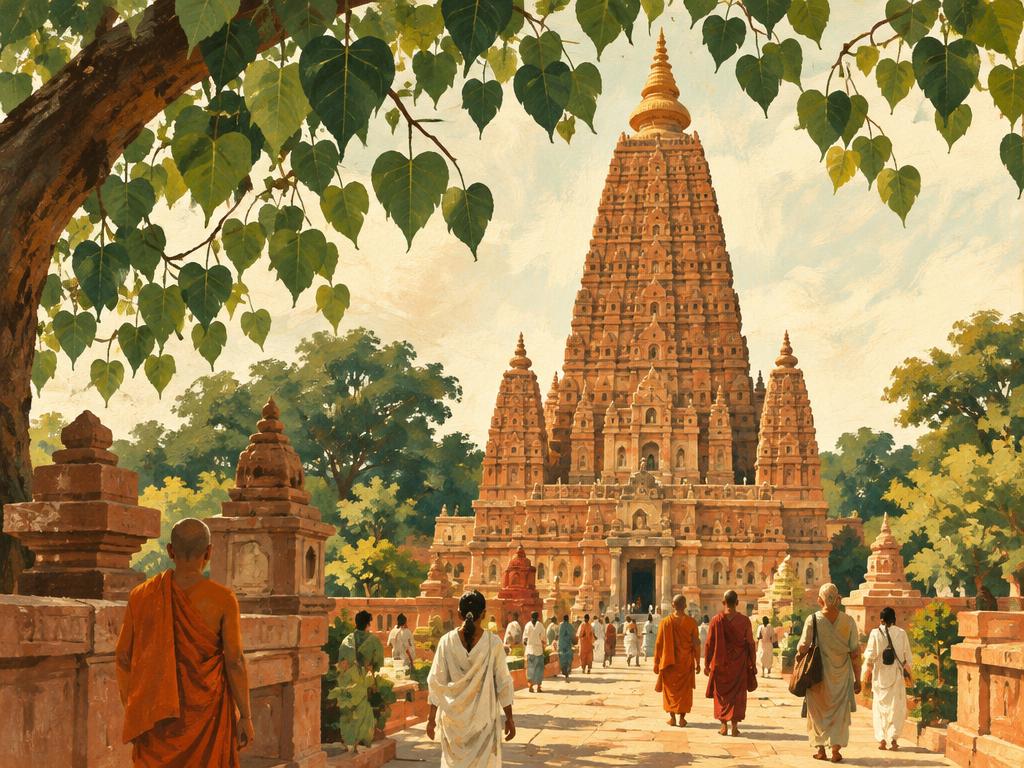
The story
Around the 6th–5th century BCE, a wandering prince named Siddhartha Gautama is said to have sat in meditation beneath a peepal tree on the banks of the Falgu river — and risen as the Buddha. That spot, and the temple raised beside it, make Bodh Gaya the most important pilgrimage site in Buddhism.
Emperor Ashoka is credited with building the first shrine here around the 3rd century BCE. The towering Mahabodhi Temple you see today, rising about 55 metres in sandstone brick, took its present grand shape largely during the Gupta period (5th–6th century CE) and was restored many times after. The Bodhi tree standing today is descended from the original through saplings carried across Asia.
In 2002, UNESCO listed the Mahabodhi Temple Complex as a World Heritage Site. Over centuries, monks and patrons from Sri Lanka, Thailand, Myanmar, Tibet, Bhutan, China, Japan and beyond have built monasteries here — so a single afternoon can take you across half of Buddhist Asia.
Why visit?
- One of the four holiest sites of Buddhism, with an atmosphere that pilgrims describe as genuinely humbling — especially at dawn when chanting fills the complex.
- The Mahabodhi Temple itself: a soaring Gupta-era stupa, the sacred Bodhi tree, and the Vajrasana (Diamond Throne) beneath it.
- A walkable world tour of monasteries — Thai, Bhutanese, Tibetan, Japanese, Sri Lankan and more, each with its own architecture and prayer halls.
- Side trips to the Great Buddha Statue (an 18-metre meditating figure), Sujata Garh — where a village girl is said to have offered the Buddha his first meal — and the caves of Dungeshwari hills where he practised austerity.
How to reach
- By train
- Gaya Junction is the main railhead, about 15 km away, with direct trains from Delhi, Kolkata, Patna and Varanasi. Bodh Gaya is a short auto-rickshaw or taxi ride from the station.
- By air
- Gaya International Airport (~12 km) has limited, mostly seasonal international services; Patna Airport (~110 km) usually offers more reliable domestic connections, then a 3–4 hour road journey.
- By road
- Frequent buses and shared taxis run from Patna, Gaya and Rajgir. Roads are generally decent; allow extra time for traffic near the temple during festival weeks.
- Getting around
- The temple core is compact and walkable. Cycle rickshaws and auto-rickshaws cover the monastery belt and outlying sites cheaply; agree fares before setting off.
Suggested itineraries
Half-day: the heart of Bodh Gaya · 4–5 hours
- Arrive before sunrise; sit in the Mahabodhi complex while morning chanting is under way.
- Circumambulate the temple and the Bodhi tree; spend quiet time at the Vajrasana.
- Walk to the Great Buddha Statue and the adjacent Tibetan monastery market.
One day: monasteries and nearby stories · 8–9 hours
- Morning at the Mahabodhi complex as above.
- After breakfast, visit three or four country monasteries — the Thai and Bhutanese ones are easy favourites.
- Afternoon drive to Sujata Garh at Bakraur, then the Dungeshwari cave temples in the hills.
- Evening: candle-lit circumambulation at the temple, then dinner in the village lanes.
Two–three days: the Buddhist circuit · 2–3 days
- Day 1 in Bodh Gaya as above.
- Day 2: Rajgir — Gridhakuta (Vulture's Peak), hot springs, and the ropeway to Vishwa Shanti Stupa.
- Day 3: Nalanda — the ruins of the ancient university and its museum, returning via Rajgir or Gaya.
Visitor essentials
- Opening times
- The Mahabodhi Temple complex is generally open daily from early morning (around 5 am) until about 9 pm; timings are occasionally extended on festival days. Confirm locally.
- Entry & rules
- Entry is free. Mobile phones are not allowed inside the main complex — leave them at the deposit counter. Footwear comes off in the inner shrine area; dress modestly.
- Facilities
- Clean toilets, drinking water and shoe stands near the complex; plenty of ATMs, pharmacies and budget cafés within walking distance.
- Accessibility
- Paths through the main complex are level and paved; wheelchair access to the inner sanctum area exists but some monastery paths are uneven. Ask at the temple office for assistance.
- Crowd note
- Expect long queues and heavy crowds during Buddha Jayanti, winter weekends and major Tibetan pilgrimage seasons.
Local perspective
We are collecting insights from Bodh Gaya's monks, guides and local shopkeepers for this section. Know someone whose voice belongs here? We'd love an introduction.
Sources & updates
- UNESCO World Heritage Centre — Mahabodhi Temple Complex at Bodh Gaya
- Bihar State Tourism Development Corporation
- Bihar Department of Tourism — Destination pages
Last verified October 2026
Suggest a correctionBest time to visit
October to March offers pleasant, cool days; December–January nights can drop near 5°C and the town is at its busiest around Buddha Jayanti (April–May). April–June regularly crosses 40°C, and the July–September monsoon brings heavy rain.