Ancient heritage
Barabar Caves
Jehanabad district, ~25 km north of Gaya
India's oldest rock-cut caves — polished by Mauryan hands, still ringing with echoes.
Plan Your Journey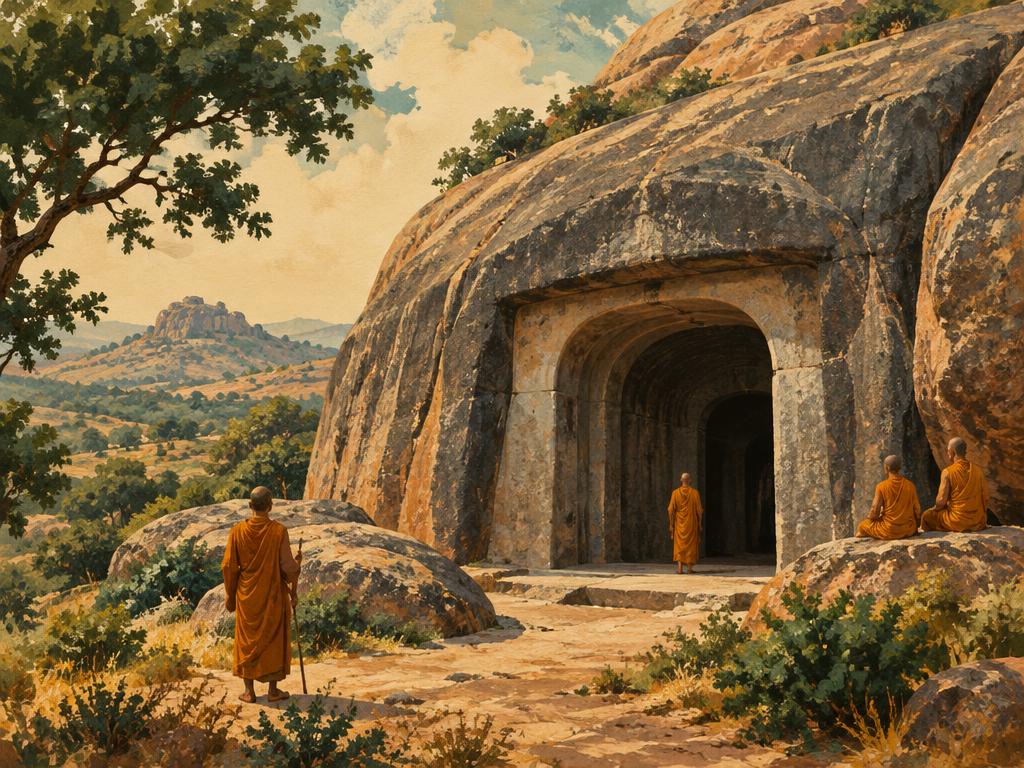
The story
Carved into a granite hill around the 3rd century BCE, during the reigns of Emperor Ashoka and his successor Dasharatha, the Barabar Caves are the oldest surviving rock-cut caves in India. Four chambers — Lomas Rishi, Sudama, Karan Chaupar and Vishva Zopri — were hollowed straight out of solid rock for monks of the Ajivika sect, an ancient rival of early Buddhism and Jainism.
The interiors are the marvel: their granite walls were polished to a glassy sheen that still reflects torchlight after 2,300 years, and the arched roofs echo every sound. The Lomas Rishi cave's curved chaitya-arch facade, carved to imitate wooden construction, became the prototype for centuries of Indian rock-cut architecture that followed — from Ajanta to Ellora.
The hill's eerie acoustics so struck E. M. Forster that he borrowed 'Marabar' for the caves in A Passage to India. Yet despite this pedigree, Barabar sees a fraction of the visitors that Gaya's famous sites do.
Why visit?
- Stand inside the oldest excavated cave architecture in India and see pre-modern polishing at a standard that still puzzles engineers.
- Clap softly inside Sudama cave and hear the walls answer — an acoustic experience that explains why these halls were chosen for ascetic retreat.
- The Lomas Rishi facade is one of the most photographed-but-least-visited monuments in eastern India.
- A genuinely quiet heritage site: most days you may share the hill with a handful of pilgrims and langurs.
How to reach
- Base town
- Gaya is the practical base — about 25 km, roughly 45 minutes to an hour by road.
- By train
- Gaya Junction is well connected from Delhi, Kolkata, Patna and Varanasi; hire a cab or auto for the onward trip. Makhdumpur, on the main Delhi–Howrah line, is nearer but has fewer onward transport options.
- Getting there
- A reserved taxi or auto from Gaya is the easiest way; public transport to the hill itself is thin, so plan the return ride in advance.
- Getting around
- From the car park, a stone path climbs moderately for around a kilometre to the caves. Sensible footwear makes it easy.
Suggested itineraries
Half-day: the caves and the temple below · 3–4 hours
- Start early from Gaya to beat the midday heat on the stone path.
- Visit the caves in order — Lomas Rishi's facade first, then the echo inside Sudama.
- Descend to the Siddheshwarnath temple at the hill's base, a lively Shaivite shrine.
- Return to Gaya for lunch, or push on to Bodh Gaya (about 30 km) for the afternoon.
Full day: Barabar plus Bodh Gaya · 8–9 hours
- Sunrise departure; caves before 10 am.
- Drive on to Bodh Gaya for the Mahabodhi complex and monasteries.
- Evening return to Gaya or overnight in Bodh Gaya.
Visitor essentials
- Opening times
- Generally open daily from sunrise to sunset, as with most ASI sites. Confirm locally during holidays.
- Entry & rules
- Entry is free or a nominal ticket; the site is protected by the Archaeological Survey of India. Carry your own water; there are no facilities at the caves themselves.
- The climb
- About a kilometre of moderately stepped path from the parking area. Simple, closed shoes are enough.
- Facilities
- Very limited — a few stalls near the base temple. Toilets and proper food are best taken care of in Gaya before you set out.
- Accessibility
- The stepped, uneven path makes the caves difficult for wheelchair users; the Siddheshwarnath temple at the base is reachable by vehicle.
Local perspective
We are gathering voices from the pujaris of Siddheshwarnath temple and the village guides who keep the hill's stories. Share your connection to Barabar with us.
Sources & updates
- Archaeological Survey of India — Patna Circle
- Bihar State Tourism Development Corporation
- Bihar Department of Tourism — Destination pages
Last verified October 2026
Suggest a correctionBest time to visit
October to February, ideally in the morning when the hill is cool and the light inside the cave mouths is beautiful. Avoid the steep path in the monsoon — granite gets slick — and afternoons in April–June are brutally hot on open rock.